Energy-proportional computing for hyperscale AI training is a design methodology where the power consumption of a system scales linearly with its utilization, ensuring that idle hardware consumes minimal energy. As large-scale artificial intelligence models demand unprecedented compute resources, this approach has become a critical pillar for sustainable data center operations. Implementing these architectures allows organizations to maximize performance per watt, effectively aligning electricity consumption with active computation tasks. Achieving such efficiency is vital as high-performance computing clusters grow in size and complexity.
Why is energy-proportionality critical for modern AI infrastructure?
Energy-proportionality addresses the massive electricity waste inherent in legacy data centers, where servers often draw significant power even when idle. By ensuring that power usage drops during low-demand periods, operators can drastically reduce their operational overhead during the fluctuating workloads typical of large-scale model training.
Modern NVIDIA GPU clusters are the backbone of current generative AI, yet they consume immense power regardless of current processing demands. Without energy-proportional hardware, the cost of running a facility becomes prohibitively high. Research from IEEE indicates that the disparity between peak power and idle power is a primary target for engineers. Minimizing this gap through sophisticated power management firmware and hardware-level state transitions is now a standard requirement for hyperscale environments. As these clusters expand, the cumulative savings from improved proportionality contribute directly to the long-term feasibility of massive machine learning projects.
How do hardware state transitions impact hyperscale efficiency?
Hardware state transitions, such as deep-sleep modes and voltage scaling, allow individual components to adjust their power consumption based on real-time task arrival. These transitions enable high-performance systems to effectively throttle down when the workload pauses during data preprocessing or model validation phases.
By leveraging advanced power management, components like specialized accelerators and memory controllers can enter low-power states in milliseconds. This granular control is essential for modern AI workloads, which are often bursty in nature. According to reporting from Reuters, major tech firms are increasingly integrating silicon-level controls to ensure that power isn’t wasted during the "dead time" between training iterations. While aggressive power throttling requires precise timing, the trade-off significantly improves the total cost of ownership for massive GPU arrays.
What role does software optimization play in power scaling?
Software optimization enables intelligent scheduling, ensuring that tasks are consolidated onto the fewest possible active nodes to minimize power leakage across the cluster. By utilizing predictive analytics, software layers can anticipate compute requirements and prepare hardware states before processing begins.
Orchestration platforms often employ load-balancing algorithms designed to keep active machines at peak efficiency while allowing others to remain in a low-power state. This approach prevents "zombie" servers—hardware that is powered on but performing no useful work. Effective software management ensures that the cluster operates closer to the theoretical maximum of its power-proportional curve. Recent studies in cloud computing emphasize that software-defined power management is as important as the physical hardware itself. This synergy ensures that the infrastructure remains flexible enough to handle sudden spikes in demand while maintaining energy discipline.
How do thermal management systems support energy-proportional goals?
Thermal management systems, including liquid cooling and variable-speed fan controls, directly influence how much energy a facility must expend to keep high-performance chips operational. Efficient thermal regulation allows systems to run closer to their thermal limits, where performance efficiency is generally higher per unit of heat generated.
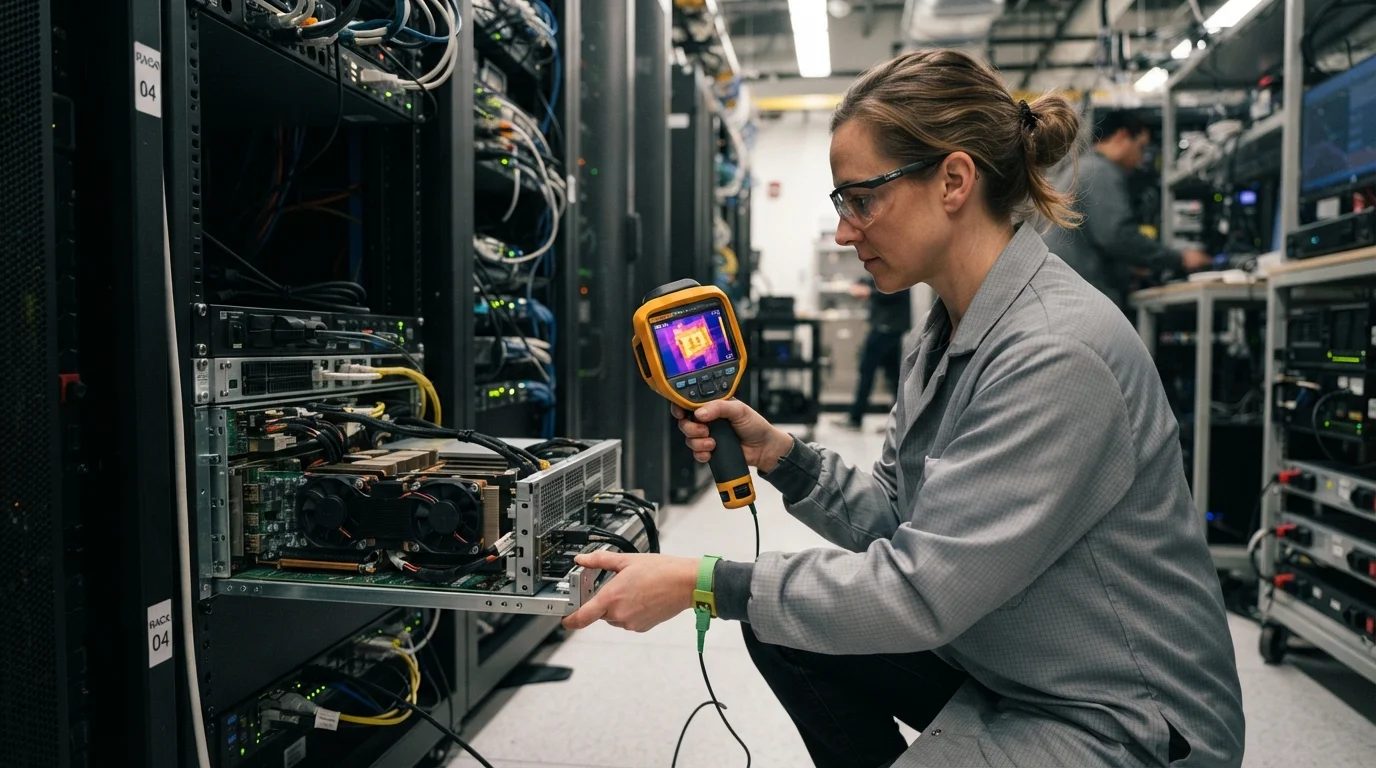
When a cluster is running at lower capacity, the cooling infrastructure must scale back proportionally to maintain overall efficiency. Using sensors embedded in the hardware, modern data centers can adjust coolant flow rates in real-time, preventing the cooling system from consuming more power than the actual compute workload. According to U.S. Department of Energy guidelines for data center sustainability, liquid cooling is becoming the preferred method for high-density AI training environments. By integrating these thermal controls with the primary power-scaling firmware, facilities can achieve a more cohesive, energy-proportional profile across the entire site.
What is the relationship between AI model size and power usage?
The relationship between AI model size and power usage is intrinsically linked, as larger parameters require longer training times and more continuous hardware engagement. As models grow, maintaining energy proportionality becomes harder, necessitating more advanced hardware that can handle intense, sustained loads without thermal throttling.
Large models like those training on thousands of GPUs create a persistent load that challenges traditional power-proportionality metrics. However, even within these large training jobs, different segments of the neural network may demand varying levels of intensity. Adaptive compute strategies allow for the efficient allocation of computational resources, ensuring that only the necessary units are firing at maximum wattage. As AI models evolve, the demand for power-efficient architecture remains constant. Engineers now focus on "algorithmic efficiency" to ensure that the number of operations performed per Joule of energy input continues to trend upward.
Can energy-proportional computing solve data center carbon footprints?
Energy-proportional computing acts as a foundational solution for reducing the carbon footprint of data centers by minimizing the energy intensity of every training task performed. While not a complete solution, it significantly lowers the total electricity required, allowing for a smoother transition to renewable energy sources.
By flattening the power profile of data centers, operators can better match their demand with the variable supply of renewable energy, such as solar and wind. This alignment is vital for corporations attempting to reach net-zero goals. Organizations that invest in energy-proportional hardware see direct results in their environmental, social, and governance reporting. Industry leaders are now collaborating with standards bodies to develop universal metrics for energy efficiency in AI. By standardizing these practices, the industry aims to ensure that the rapid expansion of AI does not compromise sustainability targets set by global environmental agreements.