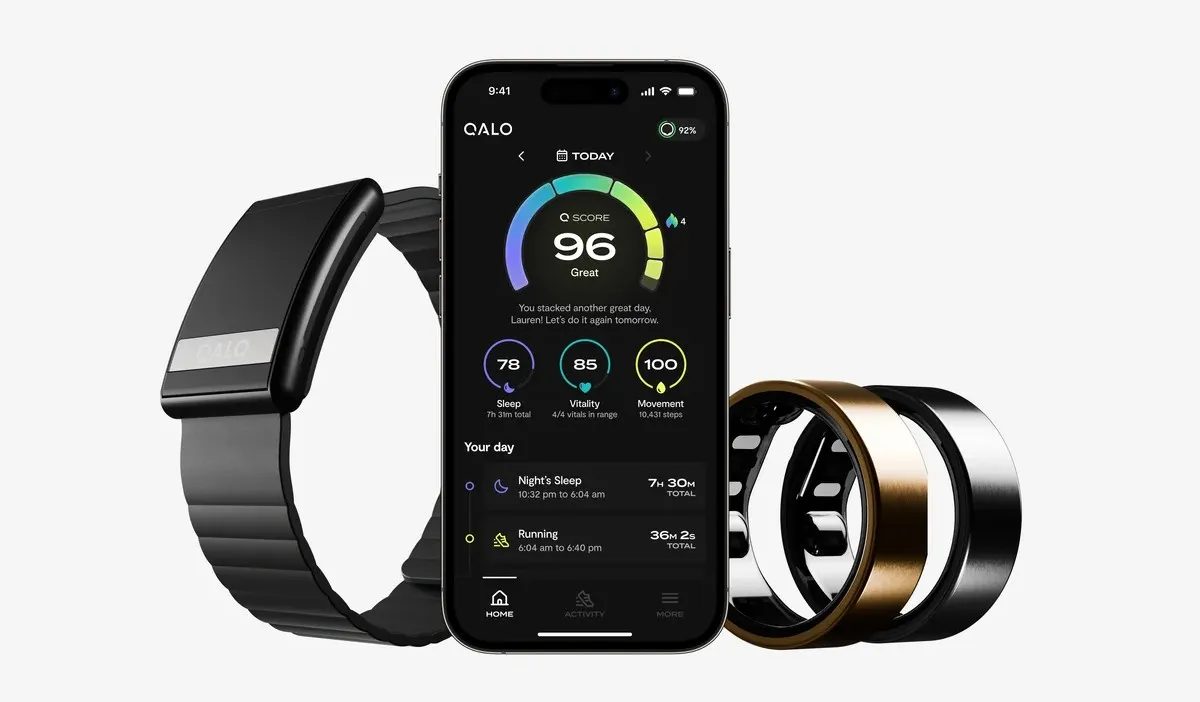
The QALO SL-1 Smart Band is a screen-free biometric tracking device designed to monitor comprehensive physiological data points throughout the day. This new entrant into the wearable technology market functions as an independent health monitor while integrating into a proprietary ecosystem alongside the company’s existing smart ring hardware.
What tracking capabilities does the QALO SL-1 offer?
The SL-1 provides a suite of internal sensors that capture movement, heart rate, heart rate variability, skin temperature, blood oxygen levels, and stress indicators. These data streams aggregate within a companion application to provide users with a singular, intuitive health assessment metric known as the Q-Score.
By focusing on these vital statistics, the device aims to mirror the functionality of established fitness trackers, such as those produced by Whoop, without relying on a traditional visual display. This screen-free design choice reduces physical bulk and enhances battery efficiency, catering to users who prefer a minimalist aesthetic. Beyond standard activity metrics, the software suite includes menstrual cycle tracking. This adds a layer of depth for users seeking longitudinal health insights. The device essentially acts as a localized data collector, syncing information to a user-controlled profile that prioritizes long-term trend analysis over real-time notifications or distracting visual alerts.
Does the SL-1 smart band require a monthly subscription fee?
Unlike many prominent players in the biometric monitoring space, the QALO SL-1 operates without a mandatory monthly service subscription for its core analytics. This pricing strategy represents a significant shift for consumers weary of recurring costs associated with digital health services.
By decoupling the hardware purchase from ongoing software fees, QALO lowers the total cost of ownership for its users. In a competitive market where subscription-based models have become the standard for data-rich fitness wearables, this move could be a critical differentiator. Consumers often look for ways to mitigate "subscription fatigue" while still gaining access to professional-grade biometric dashboards. Because the device retains all core functionality within the initial purchase price, it positions itself as a long-term investment rather than an ongoing financial obligation. This approach is particularly attractive for business professionals and enterprise users who value transparency and predictability in their hardware procurement processes and personal equipment budgets.
How does the dual-device ecosystem work?
QALO designed the SL-1 to function in tandem with its smart ring, allowing users to switch between form factors depending on their specific environment or activity level. The software architecture ensures that data from both devices feed into a unified user profile, creating a seamless longitudinal record.
| Feature | Smart Band | Smart Ring |
| :— | :— | :— |
| Ideal Use Case | High-intensity training | Casual wear/Office |
| Data Tracking | Comprehensive vitals | Passive vitals |
| Integration | Unified App | Unified App |
This synergy addresses a common frustration in the wearable industry: the inability to easily swap devices without losing data continuity. For example, a user might wear the band during strenuous gym sessions to ensure secure fit and high-frequency sensor capture, then transition to the ring for a formal office setting or sleep tracking. Because both wearables report to the same backend application, the user experience remains consistent regardless of the hardware worn on the wrist or finger. This modularity offers a unique value proposition that few competitors currently provide in their portfolios.
What is the official market availability and pricing?
The QALO SL-1 Smart Band launched with a retail price of $199.95, and customers purchasing directly through the official website receive an additional spare strap. Retail expansion is scheduled for later in the fall, with units arriving in Walmart stores nationwide.
This rollout strategy targets both the direct-to-consumer digital buyer and the casual retail shopper. By offering a bundled strap at the point of sale, the company addresses the need for durability and customization right out of the box. The decision to enter physical retail spaces after a digital-first launch indicates a desire for broad market penetration. IT professionals and tech enthusiasts should note that while the device is now obtainable, the upcoming retail presence will likely facilitate easier accessibility for those who prefer an in-person evaluation before purchase. This omnichannel approach ensures that the brand remains visible during the busy holiday shopping season, providing a tangible option for individuals looking for non-screen-based fitness solutions that compete with the major industry incumbents.
How does the Q-Score improve health monitoring?
The Q-Score is a proprietary 1-100 metric that synthesizes diverse physiological data points into a daily performance index for the wearer. This score serves as a snapshot of physical readiness and overall systemic health.
By consolidating complex metrics like heart rate variability and sleep quality, the Q-Score simplifies the interpretation of health data for the average user. Instead of manually parsing individual data points, users receive a normalized grade that reflects their cumulative state. This style of reporting is increasingly common in data-driven health management, where the goal is to provide actionable intelligence rather than raw data logs. For professionals balancing demanding schedules, such a metric allows for a quick assessment of whether to push harder in the gym or prioritize recovery and sleep. The simplicity of this score is its primary strength, as it encourages consistency in monitoring without requiring the user to be a specialist in interpreting physiological output.
What technical factors influence battery and connectivity?
Because the SL-1 lacks an integrated display, the power draw on the battery is significantly reduced compared to full-featured smartwatches. The device relies on efficient Bluetooth protocols to relay information to the host smartphone, ensuring that battery life is optimized for continuous wear.
In the absence of a high-resolution display, the hardware focus shifts to sensor accuracy and internal storage capacity. The SL-1 likely employs low-energy sensor polling to maintain battery longevity while capturing high-frequency data during movement or sleep. For modern internet of things (IoT) devices, this balance between energy efficiency and data resolution is paramount. Users expecting to track multiple days of activity on a single charge will find this design particularly advantageous. By removing the most power-hungry component—the screen—the company has optimized the wearable for its intended purpose: passive, long-term health tracking. This technical philosophy aligns with current industry trends that favor extended battery cycles over feature-heavy, short-lived daily charging routines.